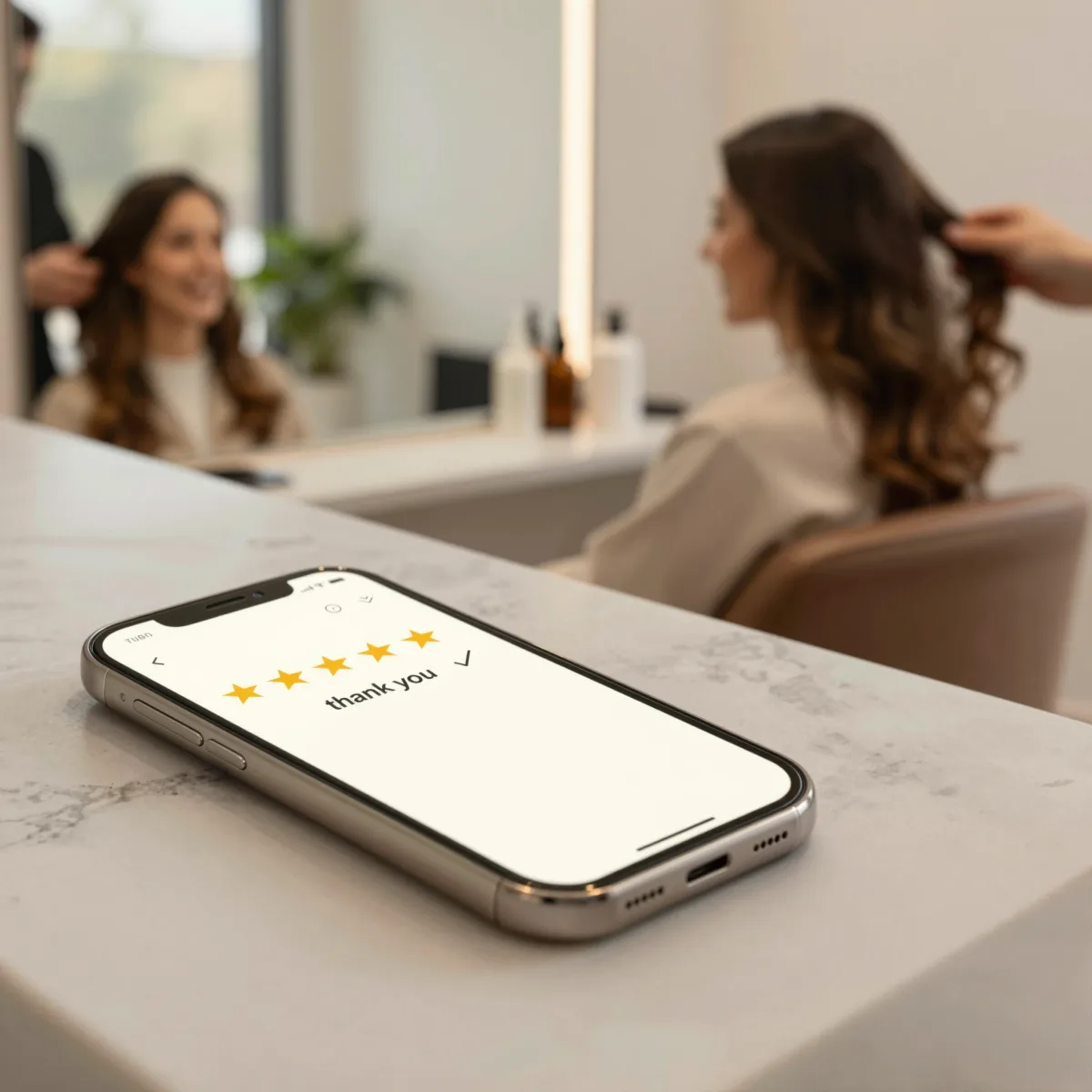
She looks in the mirror and doesn't quite recognize herself — in the best way. The color is exactly what she pictured. The cut falls the way she hoped it would. She tells you twice how much she loves it, tips generously, and books her next appointment before she's even out of the chair.
Then she gets in her car. Her phone buzzes — a text about dinner, an email that can't wait, a reminder that the kids need picking up in twenty minutes. By the time she's home, the appointment that felt like a small miracle an hour ago is just... done. Filed away. She meant to leave a review. She really did. She just never got around to it.
She's not being rude. She's not being ungrateful. She's being human.
And that gap — between how much a client loves you and how rarely that love makes it online — is quietly deciding whether the next client ever finds you at all.
Silence isn't satisfaction. It just looks like it.
Most salon owners read a quiet month with no complaints as a good sign. No news, good news — right?
Not quite. Silence from a client who loved you and silence from one who was merely fine look identical from where you're standing. You can't tell "she adored it and got distracted" apart from "it was okay, nothing special" — because both show up as nothing at all.
Meanwhile, the client who had a bad experience doesn't need reminding. She's opening Google before she's out of the parking lot.
That's the asymmetry nobody warns you about: the people least likely to need a nudge are the ones least happy with you. Everyone else — the regulars, the ones who'd genuinely sing your praises — needs to be asked. If you're not asking, you're letting the loudest, least representative voice write your reputation for you, by default, every single time.
Why loving you isn't enough to make her act
There's a well-known finding in behavioral psychology, first described by Daniel Kahneman and Barbara Fredrickson, that people don't remember an experience as a whole. They remember two moments: the peak — the most intense point — and the ending. Everything in between gets compressed or forgotten entirely.
Applied to your chair, the peak is the moment she sees the finished result in the mirror. The ending is the goodbye, the checkout, the walk to her car. That's the window where the urge to tell someone how good she feels is at its strongest.
By tomorrow, that peak is buried under a school run, a work deadline, and whatever's for dinner. The urge doesn't disappear because she stopped caring. It disappears because life simply moves faster than the thought does.
Which is why "she'll leave a review if she really loved it" might be the most expensive assumption a salon can make. Goodwill has a shelf life measured in hours, not days.
You're being judged by a reputation you didn't get to write
Here's what's happening while you wait for reviews to show up on their own:
- 97% of consumers now read reviews before choosing a local business, and 41% say they always check before deciding — up from just 29% a year earlier.
- 81% specifically check Google reviews before they'll even consider walking in.
- In beauty and wellness specifically, close to 94% check Google or Yelp before booking, and 83% of hair clients say they won't book at all once they've seen a negative review.
- The financial swing is real: research tracking rating-sensitive booking behavior has repeatedly found that even a half-star shift in your average lines up with a 5 to 9% change in revenue.
Your reputation isn't a nice-to-have anymore. For most new clients, it's the only information they have about you before they ever pick up the phone or open your booking page. If you're not actively shaping it, you're leaving it entirely to whoever happened to feel strongly enough to type something — usually the outlier, rarely the regular.
Three myths keeping good salons invisible
Ask a salon owner why they've never set up a real system for collecting reviews, and the reasons tend to sound sensible. They're just not true.
Myth #1: "If she loved it, she'll leave a review on her own"
Covered above — and worth repeating, because it's the myth that costs the most. Intention isn't the problem. Timing is. The feeling that would have produced a glowing review exists for a matter of hours, not the days it usually takes someone to sit down, remember, and type it out unprompted.
Myth #2: "Asking feels pushy, like I'm begging for compliments"
This is the one that quietly stops most owners from ever bringing it up. It feels needy. Salesy. Like you're fishing.
But flip the framing: a client who just left glowing, mid-peak, isn't being imposed on when you make it easy for her to say so — she's being given somewhere to put a feeling she already has and was going to lose by tomorrow. You're not asking for a favor. You're holding a door open for thirty seconds while it's still worth walking through.
The clients who'd never leave a review no matter how good the service was were never going to leave one anyway. Asking doesn't create pressure for them. It just captures the people who were already on your side.
Myth #3: "If I ask everyone, I'll get some bad reviews too — and that'll hurt me"
This one sounds like caution. It's actually the myth doing the most damage to your average.
Research from Northwestern's Spiegel Research Center found something counterintuitive: purchase and booking likelihood doesn't peak at a perfect 5.0 rating. It peaks around 4.0–4.7, then drops as ratings creep toward flawless. A suspiciously perfect page with six reviews reads as staged. A 4.7 with two hundred reviews — including a few honest, evenly-handled critiques — reads as real.
You're already being judged, with or without a system in place. The only question is whether that judgment is based on three loud outliers or your actual average across every client who walked through the door. Asking everyone doesn't lower your rating — it makes your rating true.
What actually works: catch the feeling before it fades
You don't need to become a marketer, and you don't need to stand at the register asking every client to "please leave us five stars." You need the moment captured automatically, before it disappears.
1. Ask the moment the appointment ends
Not next week. Not in a monthly newsletter nobody opens. Right after checkout, while she's still looking at the result in the mirror and still feeling the peak Kahneman described. That's the only window where asking feels natural instead of random.
2. Make it one tap, not a favor
If leaving a review means finding your business page, remembering her login, and writing a paragraph, she won't do it — not because she didn't love the appointment, but because friction beats intention every time. A direct link that takes five seconds converts. A search that takes five minutes doesn't.
3. See the whole picture in one place
Reviews scattered across Google, Facebook, and word of mouth make it impossible to know your real average — you only see what people stumbled onto, not what everyone actually experienced. Every request tracked in one dashboard means you're finally looking at your true reputation, not a sample of whoever felt strongest.
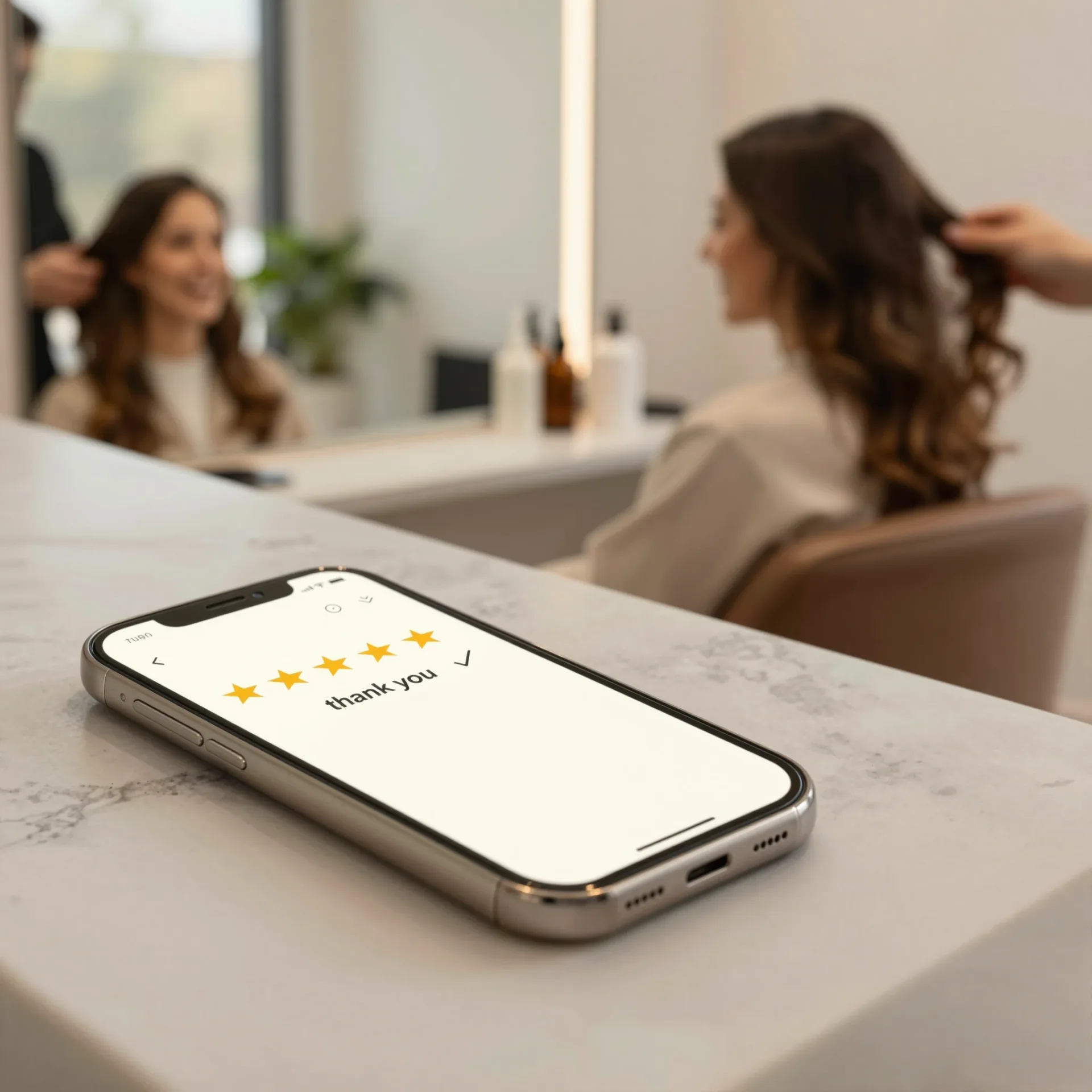
This is exactly why we built Reviews into Appointible: an automatic request sent the moment a visit is marked complete, a one-tap link to the platform that matters most to you, and every response — good or constructive — collected in one place so you can actually see the business you've built.
This isn't about becoming a different person
You didn't get into this industry to chase five-star ratings. You got into it to do work that makes people feel better about themselves when they leave than when they walked in. That part hasn't changed, and it's not what this is asking you to change.
Asking for a review isn't salesmanship. It's giving your work the credit it already earned — before the school run, the work email, and the rest of her day quietly erase it.
Somewhere in your calendar this week, there's a client who left thrilled and will never think about leaving a review again unless something reminds her in the next hour. That's not a loyalty problem. That's a timing problem. And it's fixable.
Try Appointible free and see your real reputation take shape →
Appointible is booking software built for beauty and wellness professionals — from solo operators renting a room to growing salons with a full team. Automated review requests sent the moment a visit ends, SMS and email reminders, deposits at booking, a flexible calendar, and an intuitive mobile app. Set it up in minutes, not weeks.
Related reading:
- Salon loyalty programs – a complete guide to keeping clients coming back
- You Didn't Become a Salon Owner to Chase Cancellations
- Online booking for nail salons: save time, reduce no-shows, and convert more leads
Sources
wiserreview.com/blog/online-review-statistics biz.booksy.com/blog/spa-salon-small-business-statistics ecomengine.com/blog/4-2-4-5-star-rating-sweet-spot nngroup.com/articles/peak-end-rule